
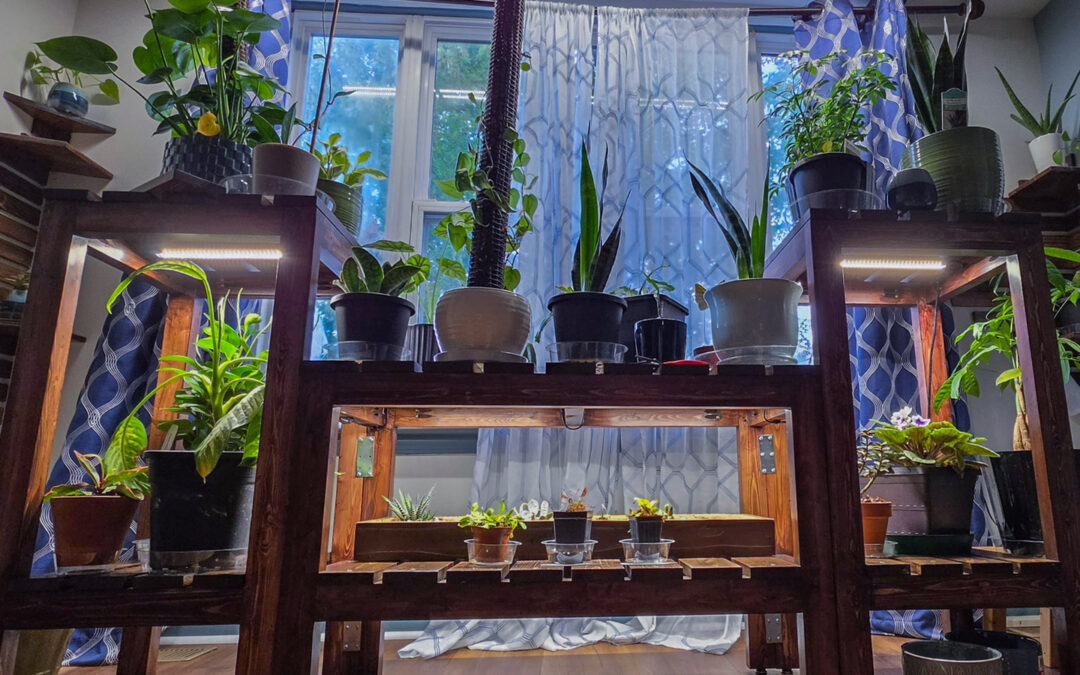
DC’s Indoor FlatScape.
MATERIALS & PROCESSES
72″ Modular Plant Gallery
18″ / 36″ / 18″ Three Module Layout
36″ / 24″ Side Stage + Center Bench Heights
16½” Overall Depth
Pine + Poplar Structural Framework
Natural 1×4 Slats Finished Plant Surfaces
Plant Specific Root Zones for Airflow, Drainage & Moisture Balance Root-Zone Structure & Aeration
Full-Spectrum LED Integrated Supplemental Lighting
DC’s Indoor FlatScape has officially moved from idea to living installation. The lumber has been milled, cut, joined, finished, and brought into the room. The integrated lighting is installed. Cable management is tucked into the architecture. The wall shelving has become part of the composition, and nearly the entire plant collection has been transplanted into root zones selected for the way each specimen actually grows.
What started as a way to organize a collection became something much more intentional. It is part furniture, part living display, part science station, and part place to disappear into for a while. The best part is that finishing the structure did not finish the FlatScape. Plants are still adapting, climbing, dividing, rooting, recovering, and occasionally teaching me that my original plan was wrong.
Meanwhile…Back on Earth
There is a whole side of my life that happens away from the cannabis garden, away from the lab, and away from the illustrated universe. It is quieter. The pace changes. I can spend twenty minutes looking at one leaf, checking the underside, turning a pot toward a window, or deciding whether a root system is telling me to leave it alone.
That is where DC’s Indoor FlatScape lives.
The FlatScape is not a grow room disguised as home decor, and it is not a shelf where I line up plants and call it finished. It is a living landscape built around different heights, leaf shapes, root systems, and ways of using water and light. Some plants climb. Some store water. Some flower. A few catch their own food. It is part plant collection, part furniture project, part science notebook, and part sanctuary. It gives this side of DC a permanent place in the story.
Music lets me disappear into sound. The FlatScape lets me disappear into something alive..
Turns Out, I’ve Always Been a Plant Guy
Cannabis did not introduce me to plants. Plants came first.
When I was a kid, my mother had a sunroom that felt huge to me. It was roughly ten by fifteen feet with windows on three sides, and at different times there were more than fifty plants living in that room. Watering them, rotating pots, removing dead leaves, cleaning around them, and keeping the room in order were part of my chores. I did not know I was learning plant maintenance. I was just doing what needed to be done.
Outside, I was the kid wandering through fields and woods looking for insects, then figuring out what those insects ate and where they lived. I was paying attention to little ecosystems before I had language for any of it. My favorite plant was the Venus flytrap, and I managed to kill more than a few of them after a store clerk told us to feed one hamburger. 😂
That story is funny now, but I like what it represents. I have always been willing to get interested, get something wrong, dig into why, and come back smarter the next time. That is still how I approach plants today. I am not trying to position myself as a guru. I study. I listen to people who know things I do not. I test ideas. I keep notes. I make mistakes, and I change course when the plant gives me better information than my original plan.
Building a Landscape, Not a Plant Rack
The physical centerpiece of the FlatScape is a custom seventy two inch modular plant gallery built specifically for this room. The design uses an eighteen inch stage on the left, a thirty six inch lower center bench, and another eighteen inch stage on the right. The taller side sections rise to thirty six inches while the center settles to twenty four. That change in elevation was intentional because I wanted the plants to create a skyline instead of sitting across one straight shelf.
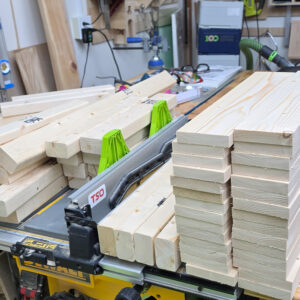 The frame was fabricated and finished in the JCWE shop, then brought into the room and joined as three removable modules. Slatted surfaces, integrated lighting, concealed wiring, leveling feet, and a water resistant finish allow the structure to function as furniture while still supporting the needs of the plants.
There was a moment when I thought I had ruined it. The finish came out warmer and more mahogany than I had imagined, and under the shop lights I hated it. Then the structure came inside. Once it was surrounded by the floor, the wall shelving, the window, and eventually the plants, the color stopped dominating the piece. It became part of the architecture.
Supplemental lighting became part of that architecture too. Full spectrum fixtures now run across the soffit above the window, while smaller fixtures illuminate the lower growing areas inside the FlatScape. The wiring is routed through the structure and raceway so the room still feels like a living space instead of an electrical experiment. Dimming, canopy distance, glare, proportions, and cable placement all mattered because I wanted this to function for the plants without making me feel like I live inside Area 51.
The existing wall shelving has also become part of the composition. Smaller specimens can live above and around the main structure, allowing the garden to move visually from the floor toward the walls instead of stopping at the edge of the bench.
Meet the Lineup
The collection now has enough variety to make one universal care routine impossible, which is exactly what makes it interesting.
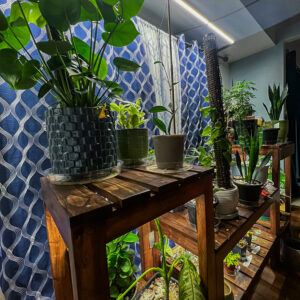 There is Monstera deliciosa, heartleaf philodendron, pothos, dwarf umbrella tree, money tree, Peperomias, African violet, Phalaenopsis orchid, holiday cactus, Hoya, Purple Passion Plant, Fittonia, Aloe, and a large indoor palm that has already taught me a lesson about letting a root zone get too dry. The succulent side includes Ghost Plants from an older parent lineage, Echeveria type rosettes, zebra Haworthia, jade and elephant bush type plants, and other dryland specimens that reward a little restraint with the watering can.
The foliage gets more dramatic with Dragon’s Tooth and Dragon Scale Alocasias, while the snake plant collection expanded during transplanting. The Black Coral became three pots, the Whale Fin became two, and the Fittonia became three separate plants. One of the best parts of repotting was discovering that the collection could grow without me buying anything.
That lasted about five minutes. 😂
The carnivorous side has now become its own little world with a Cape Sundew, Venus flytrap, Lady Luck pitcher plant, butterwort, and Nepenthes × briggsiana. Some specimens throughout the collection are still being identified more carefully, and I am comfortable saying that. Guessing a name does not make the collection more scientific.
The Science Is Under the Surface
The part of the FlatScape I am most interested in may be the part people will barely see once everything is arranged. The root zone.
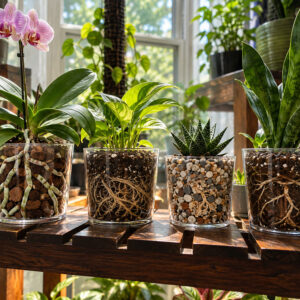 I do not believe every species should go into the same bag of soil and be expected to perform the same way. A Monstera, an orchid, a succulent, a palm, and a sundew are asking their roots to live in very different environments. Before I even think about fertilizer, I am thinking about how long the root zone stays wet, how much air remains around the roots, how quickly the pot dries, and how the plant behaves between waterings.
That thinking led to a small group of purpose built substrates for the FlatScape. DC’s Tropical Root Architecture Mix gives tropical roots an open environment with plenty of air, making it a good fit for plants such as Monstera, heartleaf philodendron, and pothos. DC’s Dryland Mineral Root Architecture Mix is designed around stronger drainage and longer dry cycles for plants such as Aloe, Ghost Plant, and Echeveria. DC’s Moisture Balanced Tropical Root Matrix holds moisture more steadily for plants such as Fittonia, Purple Passion Plant, and Peperomia that do not want to dry as aggressively. Orchids and carnivorous plants have their own specialized root environments because their needs are different enough that forcing them into one of the general mixes would defeat the purpose.
The formulas themselves can stay in the lab notebook for now. What matters here is the idea behind them. The root zone should match the plant.
The container matters too. Plastic, glazed ceramic, and terracotta all dry differently. A small root system surrounded by a large volume of wet substrate can stay damp much longer than the leaves suggest. Summer sun changes demand. Michigan winter changes it again. I would rather observe those relationships than water by calendar.
Fertilizer, Leaf Care, and Pest Maintenance
I look at fertilizer the same way. Fertilizer is not plant food in the way people usually mean that phrase. Light drives photosynthesis. Fertilizer supplies mineral nutrients that help the plant build tissue and support growth. More is not automatically better.
Concentration matters. Water quality matters. Root zone conditions matter. The amount of light a plant is receiving matters. A slow plant in weak winter light should not be pushed the same way as a fast growing tropical under strong summer conditions. For now, the newly transplanted collection has received straight RO water. I would rather let the roots settle, watch the new growth, and decide what the plants actually need before adding anything else.
Leaf care gets the same treatment. A clean leaf is easier to inspect, but I am not polishing plants simply to make them look good in photographs. Different leaves require different treatment. Some succulents carry a natural powdery coating that should be left alone. Carnivorous leaves are specialized traps. Strong oils and overly concentrated treatments can create more problems than they solve.
Pest maintenance begins with inspection, not panic. New plants, leaf undersides, nodes, stems, soil lines, and new growth all get checked. Webbing, speckling, sticky residue, or anything crawling where it should not be becomes information. When there is a problem, I want the least aggressive effective response first, followed by something more targeted only if necessary.
I also keep a planted forty gallon freshwater breeder aquarium in the house, so anything meant to affect insects, mites, or fungi gets extra respect around aquatic life.
The Carnivorous Corner
What started with a Cape Sundew and Lady Luck pitcher plant has turned into a legitimate carnivorous corner.
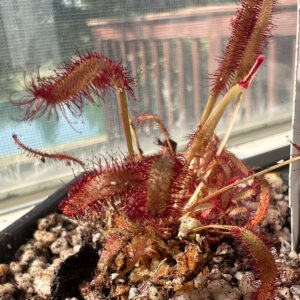 The Venus flytrap brought the childhood story full circle. The butterwort added a completely different trapping strategy. Nepenthes × briggsiana joined Lady Luck on the tropical pitcher side, while the Cape Sundew continues doing what sundews do, turning sticky leaves into one of the strangest pieces of plant engineering in the room.
These plants may be the best reminder that the FlatScape cannot run on one set of instincts. Carnivorous plants evolved in nutrient poor environments, so giving them a rich root zone because it feels generous can be exactly the wrong move. Their water quality, substrate, feeding biology, and seasonal behavior force me to understand each plant on its own terms.
That is part of what makes them fun.
What the Meters Can’t Measure
For all the science built into the FlatScape, there is another side of this that no meter can quantify. I can measure light, temperature, humidity, water, and the conditions around a root zone, but I cannot put a number on what happens to me when I slow down and spend time with these plants. That part is quieter. It is personal, and it may be the most important part of the entire project.
| FlatScape Reflection I do not come to these plants looking for perfection. I come here to slow down. Watering, turning a pot toward the light, checking a root, cleaning a leaf, or simply noticing new growth gives me a place to focus on something living and immediate. Music gives me that same kind of escape. The FlatScape gives it roots. |
Plants do something to me that music does
When I am really inside a piece of music, I stop thinking about myself. I am not checking the clock, replaying a problem, or planning tomorrow. I get to live inside the sound for a while.
Plant work can put me in that same place. Watering one pot correctly, finding a healthy white root during a repot, watching a Monstera leaf begin to open, seeing a new frond emerge from the palm, or noticing that a cutting has finally pushed new growth can turn into a meditative moment. For a little while, my attention gets pulled away from everything else and into something living right in front of me.
That is therapeutic, even when the work itself is not peaceful. A root bound plant can turn into a wrestling match. Pests can wreck an afternoon. Orchids can humble you quickly. Sometimes a project simply does not go the way I expected. Even those moments make me stop, pay attention, and deal with what is actually happening instead of what I assumed would happen.
Music lets me disappear into sound. The Flatscape Lets me vanish into something alive.
There is responsibility in that too. These plants are not props for content. I brought them into my environment, so I owe them observation, consistency, and a willingness to keep learning. The maintenance is part of the meditation.
This is The Beginning
The bench is finished now. The lights are installed. The wiring has disappeared into the architecture. The three main sections are joined, the wall shelves have become extensions of the garden, and nearly the entire collection has been transplanted into new root zones.
There is not much open real estate left, and I am fine with that. The remaining space belongs to propagation, experiments, cuttings, and whatever the plants decide to become next.
Finishing the furniture did not finish the FlatScape. It finally gave the FlatScape somewhere to begin. Leaves will get larger. Vines will climb. Pitchers will form. Cuttings will root. Plants will divide and move as their needs change. Some experiments will work. Some will fail. Some plants will surprise me and force me to rethink what I thought I knew.
Over time, this section of deancannabis.com will continue growing into its own library of individual care guides, plant profiles, propagation notes, lighting observations, root zone science, repotting lessons, pest maintenance discussions, build updates, and the mistakes that teach us something worth keeping.
What I want to share is the learning. What works, what changes, what surprises me, and what the plants teach me along the way.
This is the quieter garden. It is where design meets botany, where science gets personal, and where a room full of plants can pull me out of my own head for a while.
Meanwhile…Back on Earth.
Full steam ahead.
Knowledge grows. We just give it direction.
Keep telling us more 🔥