
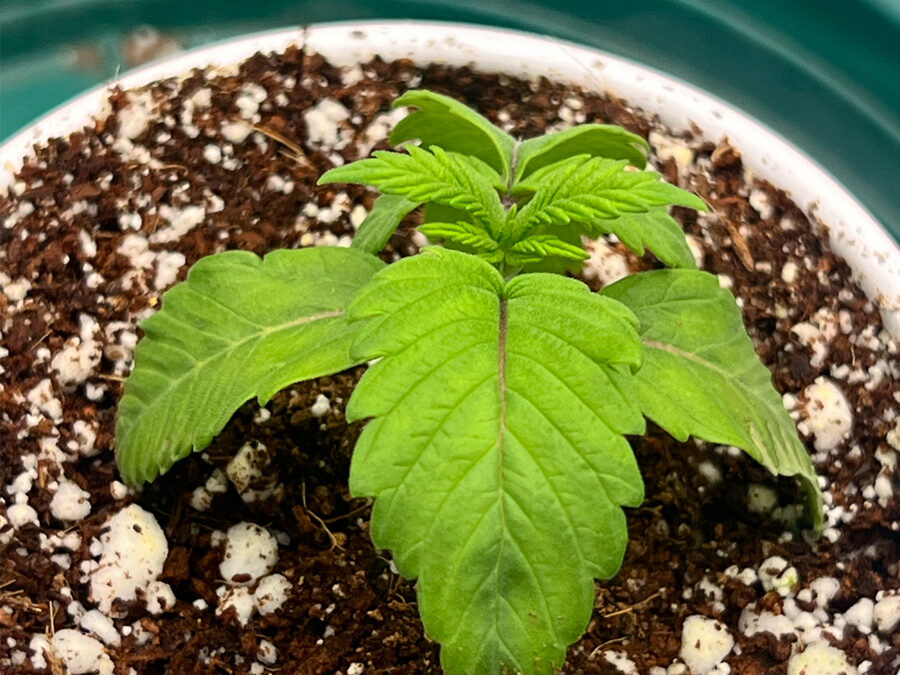
Potato Runtz continues to lead the group in overall size and structure. The older leaves remain light green with visible red coloration through the veins, while the newest growth appears healthy and active.
The Holiday Stash 2026 grow has reached Day 17 of vegetation, at least according to the calendar I am working from now.
I may have started counting the vegetative period a few days later than the plants themselves would have preferred, but that is part of documenting a real grow. Sometimes the plants are more accurate than the grower.
This week became busy while I worked on the Herbal Rotation website, so I did not post the smaller updates I originally planned. That makes this entry a longer summary of the garden’s progress, the latest feeding, the environmental adjustments, and what the plants are showing me now.
The current lineup
This run still consists of four feminized plants:
- A-01: Cheetoz
- A-02: Cheetoz
- A-03: Cheetoz
- A-04: Potato Runtz
The light remains at 60% power, and the environment has become much more stable than it was during the first two weeks.
During the light cycle, the tent is holding between:
- 74°F and 75°F
- 62% and 68% relative humidity
Humidity rises somewhat during the dark cycle, so I have started using a dehumidifier when necessary. I also opened the side of the tent temporarily to provide relief and allow some of the excess moisture to escape.
The goal is not to chase a perfect number every minute. The goal is to keep the overall environment steady enough that the plants can grow without constantly adjusting to major swings.
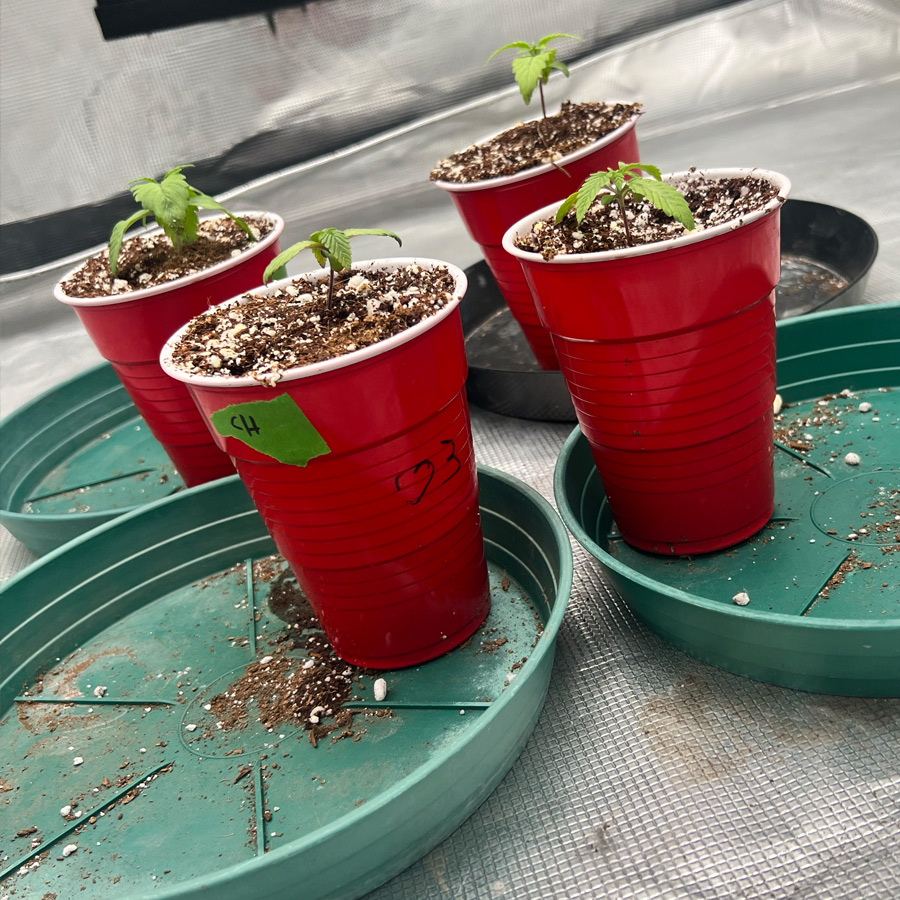
The four seedlings continue adjusting to their new feeding program. Cheetoz A-03, positioned in the foreground, remains the smallest plant but has shown noticeable improvement since receiving complete nutrition.
Yesterday’s feeding
By yesterday, the plants had consumed the water remaining in their cups and were ready to eat again.
The nutrient solution contained:
- 1 mL FloraGro
- 1 mL FloraMicro
- 0.5 mL FloraBloom
- 2 mL Botanicare Cal-Mag
The solution was adjusted to pH 5.8 and went into the root zone at approximately 70°F.
The final PPM reading came out lower than the previous feeding, even though the recipe was nearly identical. I did not test the starting PPM of the reverse-osmosis water, so I cannot make a reliable comparison between the two mixtures.
That is an important reminder for future feedings. The incoming water should be measured before adding nutrients. Without that baseline, the final number does not tell the whole story.
What the plants are showing
The weekly photographs show a garden that is still recovering rather than declining. The older leaves remain light green and somewhat drooped, but the newest growth is cleaner, more upright, and free from significant burning or necrosis. Potato Runtz continues to show the strongest overall structure, while Cheetoz A-03 remains the smallest but is beginning to close the gap.
All in all, the new growth looks healthy. That makes severe overfeeding unlikely at this point.
The older leaves may still be reflecting the earlier period when the plants were receiving only reverse-osmosis water, honey, and microbes. Coco does not provide much nutrition on its own, and the seedlings may have gone longer than ideal before receiving a complete mineral feeding.
The downward leaf posture could still involve several factors:
- The root zones previously remaining wet for too long
- Slow early root development
- The cooler basement environment
- Mild nutrient hunger
- Normal differences between individual plants
Since the newest growth looks healthier, I am watching the direction of the plants rather than expecting every older leaf to correct immediately.
The runt of the Runtz Study responds!
The biggest improvement this week belongs to the smallest Cheetoz seedling (A-03).
The runt of the grow has made significant progress since the first feeding. She had been noticeably behind, but her response suggests that she was simply hungry.
That does not mean every issue was nutritional, but it does confirm that the plants were ready for more than microbes and water alone.
This is exactly why the grow is being documented. Early differences can look genetic, environmental, or developmental, but the plants often reveal the answer after one careful adjustment.
Considering Epsom salt
For the next feeding, I am considering introducing a very small amount of Epsom salt, approximately a small pinch per gallon.
The goal would be to provide a modest source of magnesium and sulfur while continuing to monitor the lighter color and red coloration in the stems and veins.
Because the current program already includes Cal-Mag, I will keep the Epsom addition very light. More is not automatically better, especially with young plants. The new growth will determine whether the adjustment is useful.
What comes next
The immediate plan is simple:
Continue running the Vanquish 650 at 60%. Maintain the current daytime environment. Control excess nighttime humidity. Allow each cup to dry appropriately before the next irrigation. Continue the mild General Hydroponics three-part feeding program and watch the newest growth for improvement.
The girls are not perfect yet, but the garden is moving in the right direction.
There is healthy new growth. There is no visible nutrient burn. The smallest plant is responding. The environment is stable. The first signs of hunger have been addressed.
The early phase may have started a little slower than planned, but we are no longer waiting for the grow to begin.
We are officially underway.
Full steam ahead.
Knowledge grows. We just give it direction.
~DC