
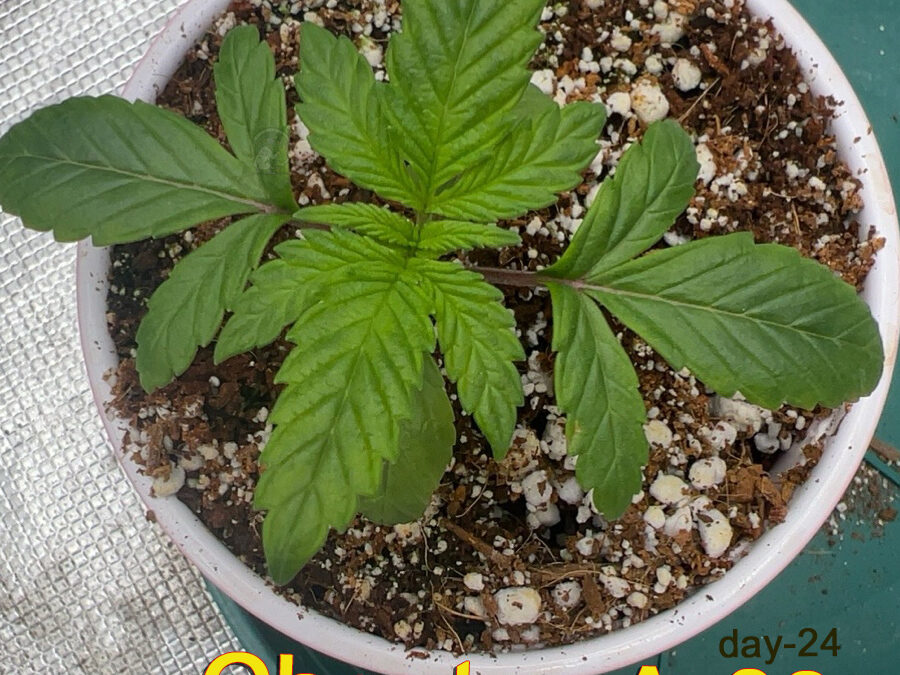
A-03 is the best-looking plant in the group. She has filled out considerably, her canopy is becoming more balanced, and the new growth through the center looks vigorous. She is still compact, but she no longer looks like a seedling simply trying to survive.
DAY 24 FIELD DATA
76°F Temperature
58% RH
270 PPM Previous Feed
5.8 pH
70°F Solution Temp
0.5 mL/gal Armor Si
The Holiday Stash 2026 grow has reached Day 24 of vegetation, and this week feels considerably different from the last update. On Day 17, the girls were still working through early growing pains. They were lighter green than I wanted, several leaves were hanging downward, and Cheetoz A-03 was clearly the runt of the group.
Seven days later, the garden is starting to look like a garden. The plants are filling out, the newest growth is coming in cleaner and healthier, and the biggest surprise of the week is A-03.
A-03 Fights Her Way Back
Cheetoz A-03 has made the strongest comeback in the tent. Earlier in the grow, she was noticeably behind the others. Her frame was small, her leaves were drooping, and she looked like she was struggling to keep pace.
Today, I would argue that A-03 is the best-looking plant in the group. She has filled out considerably, her canopy is becoming more balanced, and the new growth through the center looks vigorous.
She is still compact, but she no longer looks like a seedling simply trying to survive.
Her turnaround reinforces what I suspected during the first couple of weeks: early hunger was a major part of the problem. Once complete nutrition was introduced, she began responding. The cool basement environment, slow early root development, and moisture remaining in the cups likely contributed too, but nutrition clearly mattered.
Day 21 Feeding and the First Slica Introduction
The previous feeding took place on Day 21. The final solution measured 270 PPM, was adjusted to pH 5.8, and went into the root zone at approximately 70°F. This feeding also marked the first introduction of General Hydroponics Armor Si at 0.5 mL per gallon.
Silicon is not part of the traditional N-P-K trio, but it is widely used as a beneficial element in cultivation. Once taken up by the plant, silicon can become deposited in plant tissues and help reinforce physical structure. Growers commonly use silica to support stronger stems and leaves and to improve resilience when plants face environmental stress. Because silica products can be reactive and alkaline, I am introducing Armor Si conservatively rather than stacking heavy doses into a young nutrient program.
Light Measurements Finally Enter the Log
This week I also put an actual number on the Vanquish 650 instead of relying only on the dimmer setting. The fixture remains at 60% power. Using the Photone app on an iPhone 13 Pro Max with a strip of printer paper as the diffuser, I recorded approximately 331 µmol/m²/s PPFD at one canopy position.
The readings varied between plants even though each plant sits in its own quadrant beneath the fixture. That is expected. Plant height, exact position under the diodes, wall reflections, phone angle, and the paper diffuser can all move the reading. I am treating Photone as a practical reference tool rather than laboratory instrumentation, but it gives me a much better baseline than simply saying the light is at 60%.
The Garden on Day 24
The current lights-on environment is holding at 76°F and 58% relative humidity. The plants look noticeably more established than they did a week ago, and the newest growth is giving me a much better read on where the garden is headed.
Cheetoz A-01
A-01 remains compact and continues developing steadily. Some older lower-leaf wear is still visible, but the newer growth is fuller and healthier than it was during the early seedling period.
Cheetoz A-02
A-02 is still somewhat lighter and less dense than A-03, but the center growth is active and she continues moving forward without obvious signs of nutrient burn or major damage.
Cheetoz A-03
A-03 is the comeback plant. She has gone from being the obvious runt of the group to having the strongest overall appearance on Day 24. Her center growth is strong, her shape has filled out, and she looks dramatically better than she did before complete nutrition was introduced.
Potato Runtz A-04
Potato Runtz remains compact and healthy through the center. She showed some of the strongest early growth in the group, but the field is becoming more even as the Cheetoz plants catch up. Some older foliage still carries the history of the rougher start, while the current growth looks much better.
Day 24 Light Feeding
The cups were approaching the point where they could use moisture again. Most of them could probably have gone a little longer, but I decided on a light feeding rather than allowing the coco to become excessively dry.
The corrected Day 24 nutrient mix was 1 mL FloraGro, 1 mL FloraMicro, 0.5 mL FloraBloom, and 2 mL Botanicare Cal-Mag. The solution was adjusted to pH 5.8, and the RO water went in at 70°F. I kept the recipe intentionally mild because the plants are responding well and I do not want to create a new problem by pushing nutrients faster than they can use them.
| Next watering plan I am holding the honey and beneficial microbes until the next watering. That irrigation will be intentionally lighter, with Cal-Mag and silica as the only mineral supplements, plus the microbes and a very small amount of honey. The idea is to support the root zone without stacking another complete Flora feeding immediately on top of this one. |
From Recovery to Real Vegetation
The biggest difference between Day 17 and Day 24 is not simply that the plants are larger. They look more established.
Earlier in the grow, much of the conversation centered around what might be wrong. Was the environment too cool? Was the light too intense? Were the cups remaining wet too long? Were the seedlings simply hungry? The answer was probably some combination of those factors.
One adjustment at a time, those variables have been brought under better control. The light is stable. The feeding program is underway. Silica has entered the rotation. Environmental conditions are predictable. Most importantly, the newest plant growth looks healthy.
And A-03, the plant that looked the most questionable early on, has become the surprise of the week. We still have a long way to go, but the recovery phase appears to be giving way to actual vegetative growth.
Full steam ahead.
Knowledge grows. We just give it direction.